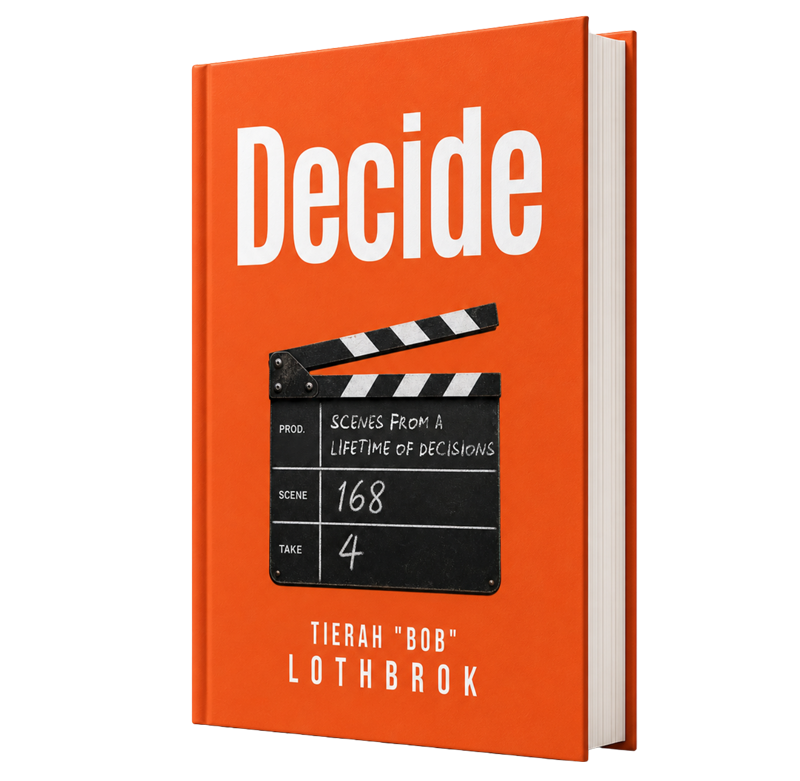
Decide
Scenes from a Lifetime of Decisions
A Transformational Novel by Tierah "Bob" Lothbrok
“Your life doesn’t change when you finally feel ready. It changes the moment you decide.”
Who do you know standing at a crossroads — an overwhelmed parent carrying everyone else’s needs, a recent graduate wondering what comes next, a young professional questioning the path they chose, a leader shouldering decisions that affect others, the creative trying to trust an unfinished vision, or someone you love standing in the doorway of yet another decision?
I wrote this book for them.
I wrote it to help them feel seen through the characters and their stories, so they might know they are allowed to live, choose, stumble, grow, and find their way into what comes next.
I wrote it in the hope that it might open deeper conversations or personal discoveries, gently reframing decision-making as part of living, not just performing.
I wrote it to offer something other than a life how-to guide, especially for readers who may not have the energy for one when life already feels like walking through quicksand.
So if someone came to mind while you were reading this, I hope you’ll place this book in their hands — not because it has all the answers, but because it may help them feel less lost in the questions, less overwhelmed by the weight of choosing, and less afraid of finding their own way.
Bob
Every entrepreneur I know has lost more to indecision than to bad decisions. Lothbrok names that truth and then goes further, exposing the real enemy: not the decision itself, but the illusion that we need certainty before we can commit. DECIDE changed how I see myself in relation to the choices that define my business, my partnerships, and my life.
Lily Kanter Co-Founder, Serena & LilyThis book snuck up on me. Funny, tender, and unexpectedly wise, this story will stay with you long after the last page. If you’ve ever second-guessed yourself into paralysis, or wondered whether your decisions define you or simply reveal you, DECIDE will meet you exactly where you are. Read it. Then go decide something.
Wayne Pendle Principal, Second Mile ConsultingI read this book during a moment when I was facing some of the hardest decisions of my life. What I loved is that it is not a formula or a checklist, but a story about becoming someone who can act without certainty. It helped me feel less stuck, more hopeful, and more able to trust myself in the messy middle.
Nadine Doyle Certified Master FacilitatorAbout the Book
Jules Levesque appears to have everything under control. A talented Hollywood set designer known for solving problems and making impossible visions come to life, he is, underneath it all, exhausted, overwhelmed, and quietly trapped by indecision.
Every choice feels loaded with consequences. As pressure builds at work, family responsibilities intensify, and a once-in-a-lifetime opportunity begins pulling him toward an uncertain future, Jules finds himself standing at the crossroads of fear, burnout, guilt, ambition, and freedom.
Set against the fast-moving chaos of Hollywood production sets and the breathtaking pull of Alaska’s wild beauty, DECIDE is a powerful, emotionally rich story about the hidden weight of indecision — and the courage it takes to finally move. It doesn’t ask readers to make better decisions. It challenges them to become Deciders.
This story explores
The Decider Principle
This book is not about making perfect decisions. Perfect decisions don’t exist.
Outcomes are uncertain, and guarantees are usually unavailable. The goal is not to eliminate uncertainty — it’s to become a Decider: someone who can make meaningful decisions at the speed life requires, even when the information is incomplete, the outcome is uncertain, the options are imperfect, and reassurance never arrives.
Many of us believe decisions are moments where we discover the right answer. More often, they’re moments where we choose a direction and begin creating the answer through our actions. Becoming a Decider means building five capacities:
Recognize how your brain shapes your choices.
Strengthen the inputs that inform your judgment.
Remove patterns that distort your thinking.
Develop the courage to act without certainty.
Align your expectations with reality.
The decision is not the end of the journey. The decision is where the journey begins.
Tierah "Bob" Lothbrok

Recommended Reading
Short write-ups on books I recommend alongside my own — click a cover to read the post.
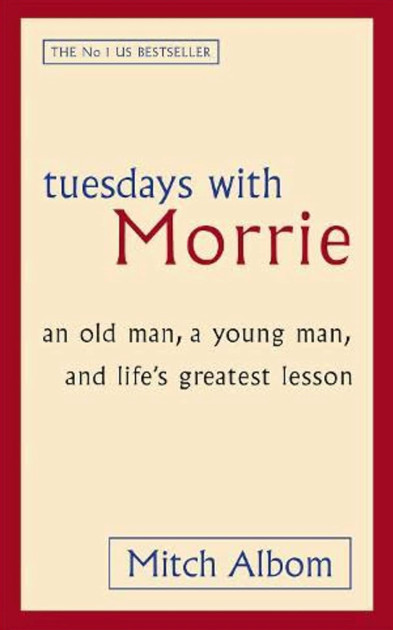
Tuesdays with Morrie
If you found yourself drawn to the emotional crossroads in Decide: Scenes from a Lifetime of Decisions, then Tuesdays with Morrie makes a deeply meaningful companion read. Where Decide follows Jules Levesque as he confronts burnout, responsibility, fear, ambition, and the cost of waiting too long to choose, Tuesdays with Morrie offers a quieter but equally powerful meditation on what matters when life strips away distraction, status, and control.
Read together, the two books form a conversation: Decide asks what happens when a person can no longer postpone the life they are meant to live, while Tuesdays with Morrie asks what wisdom becomes visible when time itself becomes precious. Both books invite readers to look beyond achievement and urgency toward love, presence, courage, forgiveness, and the choices that define a life.
Why This Book
Tuesdays with Morrie is built around a simple but lasting question: what should we pay attention to while we still have time? Through Mitch Albom's return to his former professor, Morrie Schwartz, the book turns illness and approaching death into a final classroom on how to live. Morrie's lessons are grounded in ordinary concerns every reader understands — family, work, fear, regret, aging, forgiveness, love, and the desire to live with meaning.
One of the strongest messages of the book is that a life measured only by productivity, achievement, or public success can leave a person emotionally undernourished. Mitch begins the story as someone who is busy, successful, and constantly moving, but Morrie's decline forces him to slow down and reconsider what he has been chasing.
That is why Tuesdays with Morrie pairs so naturally with Decide. Both books ask readers to look at the lives they are building and ask whether their choices reflect their deepest values. Morrie's wisdom adds a tender, reflective counterpoint to a book about decisions, reminding us that every decision is also a statement about what we believe life is for.
How the Books Speak to Each Other
- Decision and mortality: Decide explores how fear and overthinking can keep a person stuck; Tuesdays with Morrie shows how awareness of mortality can clarify what is truly worth choosing.
- Work and worth: Jules's world is shaped by pressure and performance, while Morrie's lessons challenge the idea that success or recognition can substitute for connection and meaning.
- Mentorship and reflection: Morrie becomes a final teacher for Mitch Albom; Decide can be read as an invitation for readers to become their own teacher.
- Love as the final measure: Both books point readers toward relationships, presence, and emotional honesty as the ground on which better decisions are made.
How to Make the Most of Reading Both
- Read with a decision journal nearby. After each chapter, write down the choice being faced, what fear is present, and what value is asking to be honored.
- Pair the big questions. As you read Tuesdays with Morrie, ask: "If I accepted that time is limited, what decision in my own life would become clearer?" As you read Decide, ask: "What am I waiting for certainty to give me before I act?"
- Notice the cost of delay. Track moments where characters avoid or postpone a decision, then consider where delay may now be costing you.
- Discuss both books with someone else. They're ideal for a reading group, mentor conversation, or personal retreat.
- End with one concrete choice. Let the reading become action, not just reflection.
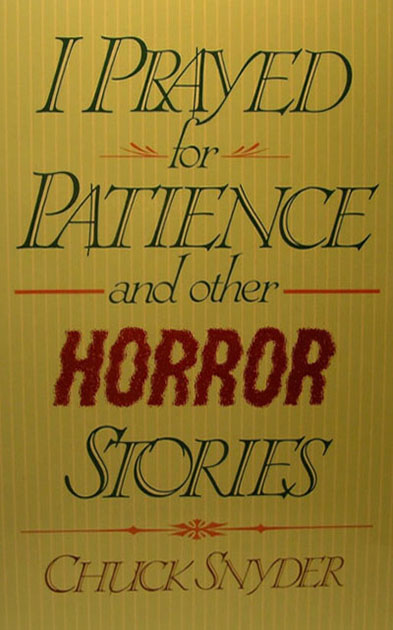
I Prayed for Patience and Other Horror Stories
I Prayed for Patience and Other Horror Stories offers a fitting counterpoint to Decide: Scenes from a Lifetime of Decisions because it looks at growth from the other side of action. While Decide centers on the weight of choices that must eventually be made, Chuck Snyder's book turns toward the quieter but equally demanding work of learning how to wait, endure, and be changed in the process.
Placed beside one another, the books create a fresh contrast between movement and formation. Jules Levesque's story in Decide follows the strain of hesitation, pressure, and self-reckoning; Snyder's book considers the moments when life slows a person down long enough to expose impatience, test trust, and reshape perspective.
Why This Book
I Prayed for Patience and Other Horror Stories treats patience not as a vague virtue but as a lived experience. The title hints at the humor and discomfort of asking for growth and then discovering that growth often arrives through challenge, rather than easy serenity.
The book's Christian living framework adds a spiritual dimension to questions that Decide raises in narrative form. Both books take seriously the inner life: the fears we hide, the pressure we carry, and the moments when we realize our reactions may be teaching us as much as our choices.
One of the strongest connections to Decide is the shared concern with character under pressure. Jules faces defining decisions that expose his values, fears, and loyalties. Snyder's book suggests that waiting can expose those same things — the question becomes not only what we will choose, but who we are becoming while we wait.
How the Books Speak to Each Other
- Choice and waiting: Decide explores the pressure of making necessary choices; Snyder's book explores what happens when life forces a person to wait before, during, or after those choices.
- Pressure and character: Jules's decisions reveal who he is becoming, while Snyder's reflections suggest that irritation and difficulty reveal the hidden condition of the heart.
- Faith and surrender: Snyder's Christian living perspective adds a spiritual lens to the questions of control, timing, and trust that also run beneath Decide.
- Growth as the final measure: Both books remind readers that meaningful decisions are also about the kind of person each choice forms.
How to Make the Most of Reading Both
- Read with a patience journal nearby. Write down where impatience appears, what desire for control is underneath it, and what growth may be invited.
- Pair the big questions. As you read Snyder's book, ask: "What am I learning in the waiting?" As you read Decide, ask: "What choice am I delaying because I want perfect certainty first?"
- Notice the difference between delay and formation. Track moments when waiting strengthens clarity versus when avoidance merely postpones responsibility.
- Discuss both books with someone else — a reading group, faith conversation, or personal retreat.
- End with one patient decision. Choose one area to act with courage and one to wait with humility.
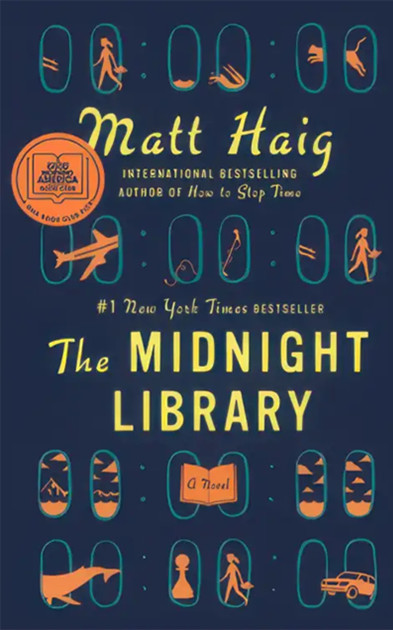
The Midnight Library
Matt Haig's The Midnight Library belongs beside Decide: Scenes from a Lifetime of Decisions not because it says the same thing, but because it approaches the same ache from another angle: the suspicion that somewhere, beyond the life we chose or failed to choose, there might have been a cleaner answer.
Decide is about the pressure of choosing before certainty arrives. The Midnight Library imagines what might happen if certainty could be granted after the fact. Taken together, they create a sharper, more restless pairing than a simple echo: one novel asks how to move forward; the other asks whether looking backward can ever truly free us.
Published: 2020. A #1 New York Times bestseller, winner of the Goodreads Choice Award for Fiction, and a Good Morning America Book Club pick, with more than fourteen million copies sold worldwide.
Near the end of Decide, Jules finally names the belief he has been living under — then sets it down: "Jules used to think decisions were doors. You picked one, walked through it, and spent the rest of your life wondering what was happening behind all the others."
The Midnight Library is a novel built entirely inside that belief. Matt Haig gives his protagonist the one thing Jules is never offered: the chance to open the other doors and walk through them.
At the lowest point of her life, Nora Seed finds herself in a library that sits outside of time. Every book on its shelves is a life she might have lived had she chosen differently. So she tries them. Glaciologist. Rock star. Olympic swimmer. Wife, mother, pub owner, scientist. One after another, she gets the answer that the rest of us only get to imagine.
Read alongside Decide, the two novels ask the same question from opposite ends of a life. Haig asks, what if I had chosen differently? Decide asks, what do I choose now, without knowing? One book is about regret. The other is about paralysis. Most of us are carrying some of each.
Why This Book
Haig turns regret into architecture. Nora Seed enters a library outside of time, where every volume contains a life she might have lived. The premise gives shape to something usually invisible: the private inventory of alternate selves, missed chances, and imagined escape routes we carry but rarely name.
That structure makes the book a natural partner for Decide, which is less interested in fantasy than friction. Jules is not invited to audition other lives. He is stuck with the ordinary difficulty of this one: work, deadlines, loyalty, fatigue, desire, obligation, and the terrifying freedom to make a choice without proof that it is the right one.
The pleasure of reading them together is in the contrast. The Midnight Library stages regret as a series of trials. Decide treats hesitation as a daily condition. One book gives its character evidence; the other withholds it. Both arrive at the same humbling truth: no life comes without loss, and no decision rescues us from being human.
Points of Contact
- Regret becomes tangible. Haig externalizes regret through Nora's books of possible lives, while Decide keeps regret embedded in conversations, delays, and unfinished choices.
- Possibility is not pure comfort. In both books, the abundance of options becomes its own burden. The problem is not simply choosing wrongly; it is believing that somewhere there must be a choice without consequence.
- Guides appear, but they do not decide. Nora has Mrs. Elm. Jules has people who interrupt, challenge, and unsettle him. Each protagonist receives help, but neither is spared the final burden of agency.
- Return matters more than escape. Neither story is finally about finding a better world. Both are about re-entering the life already underway with a different kind of attention.
The Useful Tension
A companion read works best when it complicates the original book rather than merely agreeing with it. These two do that beautifully. Haig begins with collapse and moves toward consolation. Decide begins with functionality and exposes the quiet emergency underneath it. Nora's crisis is visible; Jules's is camouflaged by competence.
- Backward and forward. The Midnight Library is about choices already made. Decide is about choices not yet made. Regret is a wound that needs healing; paralysis is a muscle that needs moving. Different problems, different medicine.
- The floor and the slow leak. Haig opens at the bottom, with a life that has visibly collapsed. Jules is employed, capable, well-liked, and quietly corroding. His crisis is the one nobody can see from the outside, which for many readers is the more familiar emergency.
- Resolution and continuation. Haig closes his loop. Nora arrives somewhere, and the lesson lands with her. Decide refuses that comfort on purpose, ending on the same beat it opened on: another page, another decision, no graduation. One book gives you an arrival. The other tells you there isn't one.
- Two frames for the same mystery. The Midnight Library is secular and existential; meaning is something Nora assembles herself. Decide holds that free will was given — that choice was bound to circumstance on purpose, and that you influence much while controlling little. Readers who want that question opened rather than settled will find both frames on the table.
- Warmth and wit. Haig is earnest and consoling. Decide is funnier — buffet lines, biodegradable confetti, a colleague who will not let Jules take himself seriously. Tender and comic are both real ways to survive a hard question.
How to Make the Most of Reading Both
- Read Haig first. Spend three hundred pages being shown the other lives. Then open Decide, where nobody shows you anything, and the choice still has to be made on a Tuesday with half the information. The order does real work.
- Keep a doors list. As you read The Midnight Library, write down your own unopened doors — the roads not taken you still think about. When you finish Decide, read the list again and mark which ones are still open. Most people are surprised.
- Watch who does the teaching. Nora learns from lives she gets to live. Jules learns from people who will not hand theirs over. Ask yourself which kind of teacher you have actually been listening to — and whether you have been waiting to experience something before you will believe it.
- Ask both questions out loud. From Haig: if I accepted that no life comes without loss, which regret could I finally set down? From Decide: what am I waiting for certainty to hand me before I move?
- Finish with one decision at velocity. Not the biggest one you are avoiding. One real one, made this week, without the full script. That is the whole practice, and both books are only rehearsal until you do it.
The Recommendation: Read The Midnight Library alongside Decide if you want the version of the question with the answers visible, and then the version where they aren't. Haig relieves you of the lives you didn't live. Decide hands you the one you're still living, and asks what you're going to do about it today.
One absolves. One mobilizes. Read in that order, they do the whole job.
The Squiggly Career
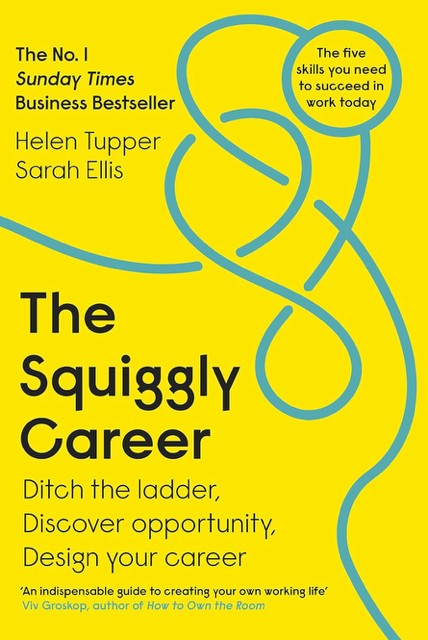
The Squiggly Career offers a practical counterpart to Decide: Scenes from a Lifetime of Decisions because it names the shape that Jules Levesque's story traces. Most career advice assumes a ladder. You start at the bottom, you climb, and every rung is a step toward a destination you named in advance. Measured against that picture, almost everyone is failing. Helen Tupper and Sarah Ellis throw the ladder out. Modern working lives move sideways, backward, and off at angles. That does not mean anything has gone wrong. It is just what a career looks like now, and their book is about getting good at it on purpose.
Placed beside one another, the two books arrive at the same geometry from different directions. Jules ends Decide realizing that life was not a hallway with a limited number of exits. It was closer to the sprawling, slightly ridiculous maps from the graphic novels he loved as a kid, full of tunnels looping back and whole kingdoms hidden inside choices that seemed small at the time. Tupper and Ellis call that a squiggle. Jules calls it a map of looping tunnels. Either way, the line is not straight, and it was never supposed to be.
Why This Book
The squiggle is not a consolation prize. That is the argument, and it is the reason this book belongs beside a novel about deciding.
A ladder only rewards one kind of move: up, on schedule, as planned. Every other move looks like lost ground: the lateral step, the pause, the detour, and the role you took because the timing was right, not because it was next. Tupper and Ellis make the case that those moves are often where people gain the most: range, relationships, and a clearer sense of what they are for. The career is not squiggly because you failed to climb. It is squiggly because that is how a person accumulates a life.
What makes the book genuinely useful, rather than merely reassuring, is that it is a career guide and handbook built around five learnable skills: strengths, values, confidence, networks, and future possibilities. Each one comes with interactive exercises attached. Notice what is missing from that list: a plan. Their fifth skill is about possibilities instead of plans, because a plan assumes you can see far enough ahead to make one. Instead of asking you to predict, they ask you to prepare, stay curious, and keep several doors warm. That is Decide's whole thesis in a form you can work through. You will never have the information. Commit anyway, and keep moving.
The two books also divide the work differently, and that is part of their value together. Tupper and Ellis give you a guide and a set of exercises. Decide gives you a man on a soundstage trying to choose between three shades of the same paint. One turns the problem into something you can name, examine, and practice; the other lets you feel what the problem costs from the inside. The exercises land harder once you have watched someone fail at them.
A book about designing your career also has to assume you have room to design, and the squiggle it describes is a professional one. Decide sits with the harder case. Jules's squiggle includes his mother's progressing care needs and the moments when you know what you would choose and that option is not available. You influence a lot. You control less than you want. Careers are the easiest squiggle to talk about and rarely the hardest one to live.
How the Books Speak to Each Other
- The ladder and the hallway: Decide clears away the hallway of doors and The Squiggly Career clears away the ladder. They are the same false picture in two different costumes, one about life and one about work. Both books replace it with something that loops, doubles back, and still gets somewhere.
- The loop through Cascade: Jules leaves Los Angeles for a trial period at a Seattle studio, turns the job down, and comes home to the city he started in. By ladder logic, the loop nets zero. By squiggle logic, it is the move that mattered, because the opportunity waiting for him in Los Angeles exists only because he went.
- Confidence as a skill, not a personality: Jules is not stuck because he lacks information. He understands the situation perfectly and still cannot move. Tupper and Ellis treat that gap as trainable, not innate. The thing standing between you and a decision is not who you are. It is a muscle.
- Strengths are found by doing, not by knowing: in his final interview, Jules says something he could not have said in Scene 1, that his gift is not bringing his own vision but helping other people find theirs. He learned that by living the squiggle. The exercises get you there on purpose.
- Opportunity arrives through people: Jules gets to Cascade at all because Lonnie tells Remy, her friend since college, that he is not shiny but he is solid. Beck notices him there, and later puts him in the room for the reboot. None of that is networking in the transactional sense, which is precisely the distinction Tupper and Ellis draw. A network is built out of relationships kept warm, and it delivers when no plan could have.
How to Make the Most of Reading Both
- Draw your own squiggle first. Before you read either book, sketch your path on one page. Include every move that felt like going backward. Keep it. You will want it later.
- Mark the decisions, not the jobs. Go back over that line and put a dot at every point where you actually chose something. Then look at how many of the best turns came from a detour rather than a plan. That is the entire argument of both books, drawn in your own handwriting.
- Run the five skills against the scenes. Strengths, values, confidence, networks, possibilities. Pick any scene in Decide where Jules is stuck and name which of the five is missing. It is a fast way to diagnose your own stuck places, because you will start doing it to yourself by about scene twelve.
- Do one exercise badly. Interactive learning guides have a failure mode: you read them and never pick up the pen. Choose one exercise and complete it imperfectly this week. Done is better than perfect. Carlos says that to Jules on the first page, and it is the only reason any of this moves.
- Then make one real decision. Not the biggest one you are avoiding. One actual choice, this week, without the full script. The squiggle is made of those, and no amount of reading substitutes for adding a turn to your own line.
Recommendation: Read The Squiggly Career alongside Decide if you have ever looked back at your own path and quietly apologized for it. One gives you the shape, the other the nerve to add to it. You do not owe anyone a straight line. You owe yourself the next turn.
Podcast Tour
Interviews and appearances will be added here as episodes go live — check back throughout the release.

Booking a podcast? Reach out via the press contact below.
Get in Touch
Media Inquiries
For interviews, features, or review copies, reach out directly.
press@decidewithbob.comSpeaking & Events
Available for keynotes, panels, and book club conversations.
events@decidewithbob.comShare Your Decision
Read the book or heard the podcast? Tell us about a decision you made and where it took you.
Scenes@DecideWithBob.com